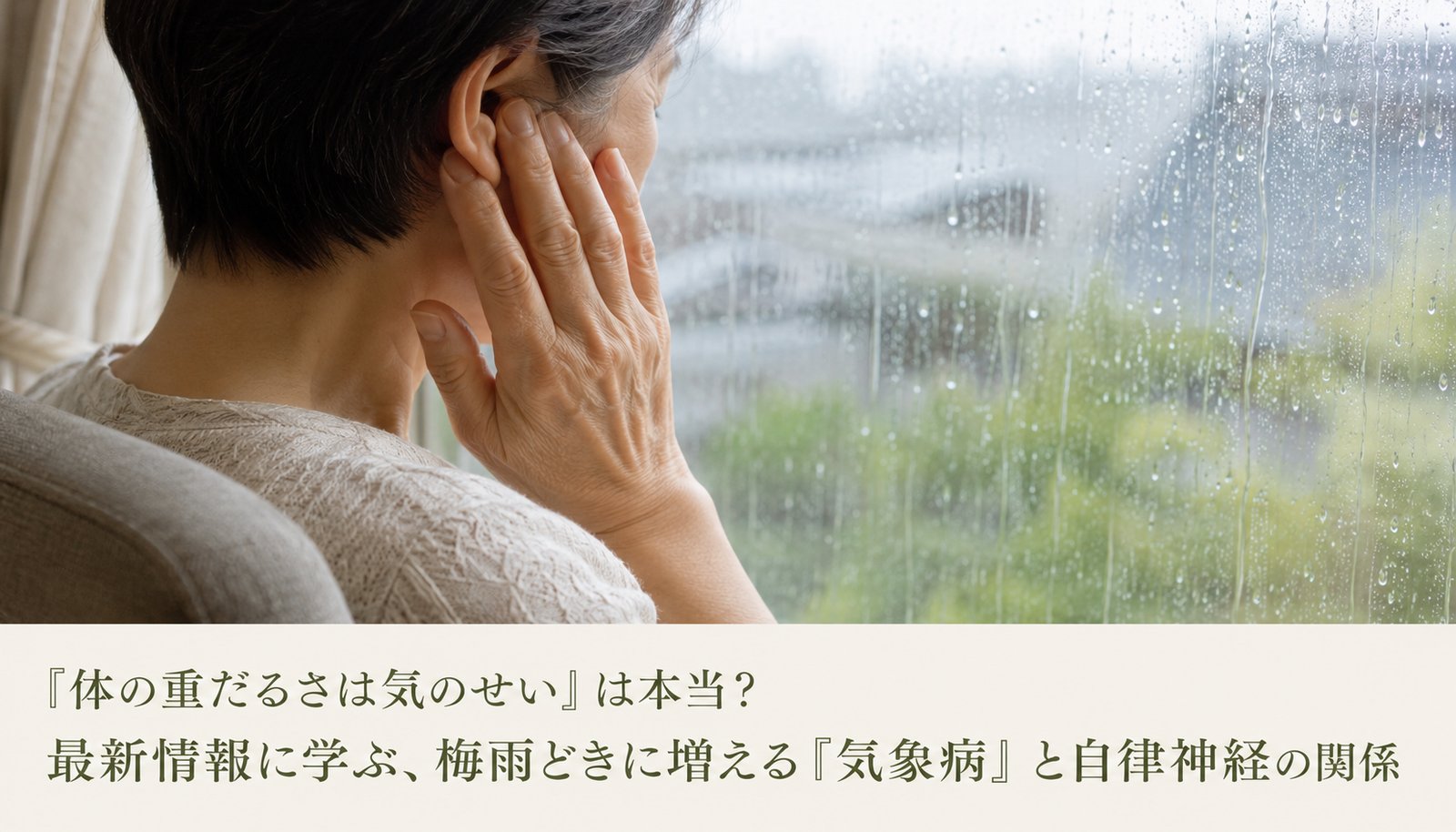
Is “Feeling Heavy and Sluggish Is Just Imagination” Really True? What Recent Insights Teach Us About Rainy-Season ‘Weather Sensitivity’ and the Autonomic Nervous System
A heavy head, sluggish body, or a low mood for no clear reason on rainy days — many of us brush this off as “I must be tired” or “it's just my imagination.” In June 2026, a psychosomatic and psychiatric clinic shared an explainer on “weather sensitivity” — physical and mental symptoms triggered by changes in weather — covering both the mechanism and how to manage it. Here's an easy-to-follow summary for readers in midlife and beyond.
Three Points the Explainer Makes
- “Weather sensitivity” isn't an official medical diagnosis but a general term for discomfort that arises when the body can't fully adapt to changes in air pressure, temperature, and humidity, the explainer notes. Because tests often don't reveal any abnormality, it's easily mistaken for “just imagination” or “laziness,” even though it stems from a clear bodily mechanism, it explains.
- The workings of the “inner ear,” which senses changes in air pressure, are pointed to as a trigger for disrupting the autonomic nervous system. When the inner ear picks up a sudden change in air pressure, that signal reaches the parts of the brain involved in regulating the autonomic nervous system, which can bring on headaches, dizziness, fatigue, and low mood — symptoms that tend to appear right as air pressure starts to drop, before the weather fully turns.
- People with hormonal fluctuations, chronic issues like shoulder or back stiffness, poor circulation, or low blood pressure are described as more prone to the effects of weather sensitivity. Serious, sensitive personalities and those who tend to feel stress easily are also noted as showing a similar tendency.
What We, in Midlife, Should Keep in Mind
This explainer conveys that heaviness in the body or a dip in mood isn't a matter of willpower or constitution — understanding the underlying mechanism can help you manage it more skillfully. The following commonly recommended habits are said to help you cope with weather sensitivity.
- Try self-care that promotes circulation around the ears, such as gently pinching and moving the area around your ears
- Check information on upcoming pressure changes, and keep plans light on days you feel uneasy
- Support a steady daily rhythm that helps balance the autonomic nervous system — get morning sunlight, soak in a comfortably warm bath
* The above are commonly recommended general health habits and do not guarantee improvement or treatment of any specific condition. If symptoms persist or affect daily life, don't push through it — consult a medical institution.
Source: Kamiyacho Charis Mental Clinic press release (via @Press, June 13, 2026, Japanese)
We offer DENBA Health, a spatial-potential care device that supports your everyday conditioning.
Learn more about DENBA HealthLast updated: July 2, 2026